Rohan’s ravine expedition
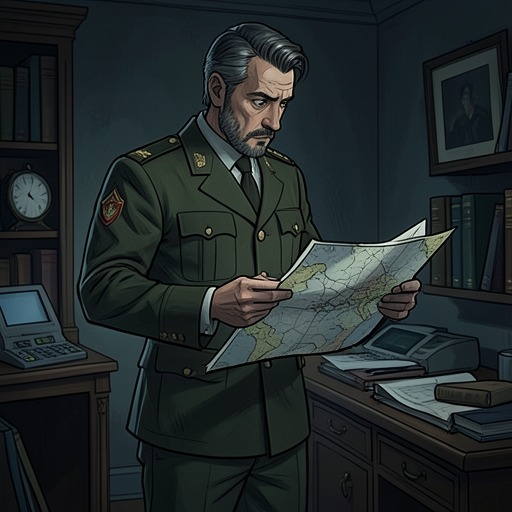
The InvincibleRohan’s ravine expedition is the rescue mission that turns the Invincible’s organized exploration of Regis III into an unmistakable human catastrophe. Rohan enters the ravines seeking four missing members of Regnar’s team, but the expedition encounters the black mechanical cloud at the precise point where the convoy’s protective system must be interrupted. The men are not simply killed: most survive in an altered, unrecognizing state, while Rohan returns with the knowledge that the planet’s defensive mechanisms can penetrate the expedition’s technological order.## Mission and Expeditionary Structure Rohan undertakes the expedition after detecting the tracks of the four missing men with olfactometric sensors, described as “electric bloodhounds.” The missing personnel are suffering from amnesia and wandering through a rocky, pathless landscape where hunger and thirst would eventually kill them, so the search is presented as an immediate rescue rather than a speculative excursion. Their traces lead into a broad, shallow ravine whose sides become progressively steeper, making it unlikely that the men could have escaped upward.
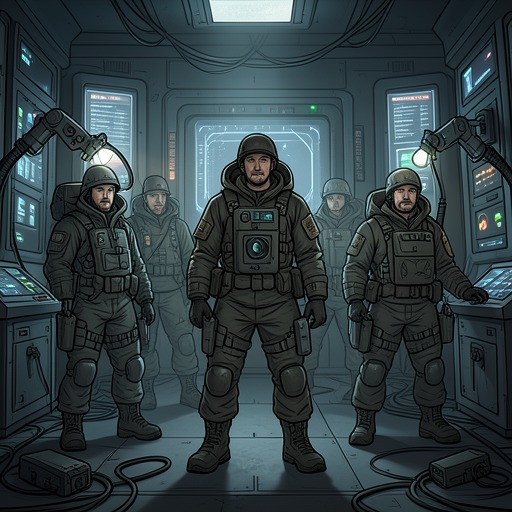
The convoy is built according to degree three procedures. It includes two large energobots, four all-terrain caterpillar transporters, and a small amphibian craft carrying Rohan, the driver Jarg, and Terner the bosun. An unmanned energobot leads the column, followed by Rohan’s vehicle, the four personnel carriers, and a second energobot at the rear. The two energobots normally provide a force field covering the entire group, turning the expedition into a moving technological enclosure rather than a collection of independent vehicles. That arrangement protects the convoy, but it also makes the mission dependent on the continuous functioning and correct coordination of its machines.
The ravine grows increasingly hostile even before the attack. The stream dwindles beneath loose rock, the passage twists beyond sight, and the slopes become covered with dense metal bushes three to five feet high. Impulsometers and magnetic sensors register increasingly varied activity. Above the blackish metallic thicket, the air seems to tremble, while wisps resembling smoke drift over the bushes; Jarg compares the distant clouds to swarms of small insects. The expedition therefore advances through a landscape whose apparent vegetation is already connected to an unseen, mobile threat.## The Force-Field Gap The immediate crisis begins at a narrow gateway in the rock. Technicians determine that the convoy cannot pass through while maintaining the force field in its usual configuration. The field can assume only forms such as a sphere, ellipsoid, or hyperboloid; although the team has previously compressed it into the shape of a flattened balloon to pass narrower sections, this gateway is too restrictive. The expedition must therefore expose itself to the environment in order to continue.
Rohan consults Tomman the physicist and the field technicians, and they devise a controlled compromise. The lead energobot will pass through with its field switched off, then reactivate the field on the far side. The transporters and Rohan’s amphibian will cross while protected only from below or from selected directions, and the rear energobot will restore complete coverage once it reaches the other side. The plan succeeds mechanically at first: the lead machine reestablishes its shield, and the vehicles begin moving through the defile.
The attack arrives during this moment of partial exposure. A bizarre judder shakes the air, and the bristling walls of the ravine begin to smoke. A black cloud erupts from the metallic growth and rushes toward the convoy. Part of it burns against the forward energobot’s force field, but most of the mass passes over the shield and descends upon the machines still in the passage. Rohan orders Jarg to activate the rear energobot and connect its field with the forward one, because the danger from a possible rockslide has become secondary to the approaching cloud.
The rear field does not activate. The later technical explanation is that the klystrons had overheated after operating in the rising current. A few more seconds might have allowed the system to engage, but Jarg panics and abandons the amphibian instead of trying again. Rohan attempts to hold him, then reaches for the controls himself, but the opportunity has already passed. The failure is therefore not merely a flaw in hardware: it becomes a chain of environmental pressure, procedural necessity, overheating machinery, and human panic. The convoy’s defensive network breaks at its narrowest point.## The Cloud Attack and Its Survivors The black cloud sweeps over the unprotected vehicles. Its attack is described as a black deluge in which men writhe against the boulders, run blindly, or crawl into the wiry scrub. Rohan remains partly outside the amphibian, not because he has consciously chosen a heroic sacrifice but because, as he later explains, he is no longer thinking about anything. The scene strips away the conventional distinction between courage and terror: bodily exposure continues while conscious intention has temporarily disappeared.
The cloud then changes its mode of action. The struggling men gradually stop moving. The mass divides into funnels, forming a local whirlwind over each victim and brushing against the torso or only the head. It withdraws upward between the ravine walls, obscures the fading sky, and finally slips back into the rocks and vanishes into the black mechanical growth. Tiny black specks scattered among the motionless bodies are the only visible evidence of the attack. The cloud’s withdrawal makes the result more disturbing, not less: the violence is brief, organized in its effects, and leaves no conventional corpse to explain what has occurred.
Rohan searches for Terner and finds the bosun lying apart from the vehicle, laser-gun butts still pressed against his chest. The rescued men are alive, but they no longer recognize Rohan and do not speak. Most lie or sit calmly; several stand, approach the vehicles, and touch their sides with the slow, clumsy gestures of blind people. The expedition has therefore achieved a grotesque version of its objective. It finds the missing personnel, but returns them neither to their former identities nor to ordinary human communication.
The outcome also raises unexplained exceptions. The cloud does not attack Rohan or Jarg while they remain in the amphibian, and Terner is unaffected until he leaves it. Jarg runs away and later returns, probably after realizing that he is too far from base to walk back with his limited oxygen supply. These irregularities prevent the attack from being reduced to a simple weapon with a known target. The expedition survives only in fragments of understanding, while the mechanism of selection remains uncertain.## Rohan’s Rescue and the Expedition’s Cost After the attack, Rohan has only his small amphibian available for transport. Two of the larger vehicles have collided at the narrowest point of the defile and cannot be separated without a crane. The rear energobot can carry no more than five people, but nine incapacitated men remain alive. Rohan gathers them, ties them together so they cannot wander away or injure themselves, and places them within the protection of the energobots. He chooses not to take anyone with him because the amphibian is unshielded and he prefers to expose only himself if another attack occurs.
By nightfall he has completed this improvised containment operation. He backs the rear energobot into position, activates both transmitters remotely, leaves the men tied within the protective field, and drives back toward the base. The rescue is thus not a triumphant extraction but a solitary return undertaken after the convoy has ceased to function as a convoy. Rohan preserves the men’s physical lives by converting them into protected, restrained bodies, while accepting personal vulnerability in order to summon help.
Within twenty-seven days of the Invincible’s landing, almost half its crew has been incapacitated. The ravine expedition is the event that gives this figure its human shape: the crew’s losses are not an abstract operational statistic but the consequence of a rescue attempt carried out under established safety rules. The expedition’s disaster forces the command to confront whether further searches can be mounted before the missing die, or whether withdrawal must be accepted as the only rational course.## Meaning Within the Planetary Conflict The ravine attack becomes evidence for the broader interpretation of Regis III’s black mechanical formations. The planet’s geological record shows that land life disappeared over millions of years as metallic strata appeared, while later discussion emphasizes that life survives in the ocean but not on land. The expedition supplies the immediate, bodily counterpart to that deep-time history: whatever destroyed or displaced terrestrial life is still active, and it responds to living and intelligent organisms without behaving like a human enemy.
The expedition also exposes the limits of the human expedition’s confidence in technology. Energobots, sensors, armored transporters, amphibious vehicles, and force fields permit Rohan to enter territory that would otherwise be inaccessible, yet the same apparatus creates a vulnerable dependency. A narrow rock gateway forces the field to change shape; the altered configuration overheats the field machinery; panic interrupts the recovery procedure; and a cloud able to scatter, multiply, and reappear defeats the convoy’s tactical assumptions. The machines are indispensable, but they do not place humanity outside the planet’s ecology.
Later analysis describes the mechanisms as inanimate, highly adapted to the conditions of Regis III, and capable of destroying intelligent or living things without possessing a strategic plan. Their apparent lack of reason does not make them harmless. On the contrary, they are difficult to defeat because they can disperse, regenerate, and move elsewhere when attacked. The ravine expedition is the scene in which this paradox becomes concrete: an opponent need not hate, plan, or seek revenge in order to produce consequences that resemble deliberate annihilation.
For Rohan, the expedition contributes to a change in the moral meaning of the mission. In the wake of the disaster, the human desire to avenge the Condor’s crew and continue “conquest at any cost” becomes increasingly indefensible. The ravine has shown that the expeditionary force is not confronting a rival civilization in a contest governed by mutual intentions. It is intruding into an established nonhuman equilibrium and paying for the assumption that superior weapons confer the right to remain. Rohan’s ravine expedition therefore marks both a rescue attempt and a threshold: beyond it, survival can no longer be separated from the question of whether humanity should continue its attack.